Migration online logoMigration online
Czech
A specialised website of the Multicultural Centre Prague focusing on migration issues in Central and Eastern Europe. It maps migration reality, research and policy, offers a range of articles, interviews and reports and promotes debate among experts, public administrators, NGOs and the wider public.


E-library

“Access to a good education and to the labor market is essential for integration of immigrants into a new society”. Interview with Barbara John, former Commissioner for Integration and Migration in Berlin

Barbora Tošnerová | 30. 10. 08
Source: migrationonline.cz
Theme: Integration
The interview deals with Berlin’s attitude towards the integration of immigrants in the 1980s and 1990s. From 1981 to 2003, Barbara John was the first Commissioner for Integration and Migration in Berlin. She draws from her extensive experience when speaking about the importance of integration, problems she had to tackle at the beginning of her career and about the change in the attitude towards foreigners.

Barbara John was the first Commissioner for Integration and Migration in Berlin from 1981 to 2003. Today she is a member of the European Commission against Racism and Intolerance of the European Council (ECRI). She is also an adviser to the German Ministry of Interior on integration courses and is engaged in an educational project for teachers of German as a foreign language.

What do you consider as the most important aspect of integration of immigrants?

In my opinion the most important aspect of social integration for immigrants is to have access to a good education and to the labor market. If you are excluded from the education system and from participation in the labour market, you cannot climb up the social ladder, you will always be a person of second class status, and even up until the age of twenty, thirty, or forty your children will remain second class citizens because they cannot become successful if they are deprived of an appropriate education. Therefore, education and participation in the labour market are the most important things for successful social integration. Language is merely instrumental. You need language to be successful in education and participation in the labour market. But to have only language skills without a job or education is not enough.

How would you describe an integrated migrant?

I think that there can be no exact definition of an integrated citizen; neither can there be a general definition of an integrated migrant. I think that it is good that we are unable to define people in simple terms. We should not have stereotypes applied to people, because who is advocating these stereotypes? I think we can distinguish a good citizen and a not-so-good citizen. For me, a good citizen is somebody who uses his individual potential to contribute to society, and not only for his own benefit. He should dedicate himself to public good, he should be interested in politics, he should do some work beside his job for the well-being of the society. On the contrary, the bad citizen is somebody, who is interested only in his personal well-being and who does not contribute to his citizenship. And I think this is same with immigrants. They should participate in public life and they should contribute to society. But the precondition is that we let them participate.

What activities enabling immigrants to become part of the society did you support?

My first steps were to ensure adequate funding was given for the development of organizations as these are important in the German framework. Initially financial aid was offered to these organizations to enable them to develop successfully. Once the organizations are up and running they can be directed to implement certain tasks and to develop integration programmes. It is only through entering public life that people may have the opportunity to participate publicly. In the end I supported about 80 different minority organizations of different activities, for example organizations for women, for children, for parents and so on.

How does Berlin’s contemporary integration policy differ from its integration policy of the 1980s?

When I started, nobody wanted to hear about integration of immigrants. I constantly tried to change this. I always said to the German people, they are here and if you do not like them, you do not have to like them, but they deserve to have a fair chance to become citizens. In the end we had a lot of people who took up German citizenship, we had infrastructure for the migrants and they had their own organizations. Most importantly the majority population finally began to accept that these people belonged to the city, that they were, and are now, part of the city. A change in attitude towards immigrants took time, there is no longer an atmosphere of hostility and it has become easier for people to get residence permits, working permits and family reunification. Everything has become easier. They are now legally more accepted, and also, they are socially more accepted.

What goals did you have when you began your work? What did you want to change?

My goal was that the immigrants would become a part of the city and that they would get the same chances as everyone else. That they would not have to adopt the German way of life, and that they could continue their own way of life, their own businesses and religions, but also that they must abide by the law and contribute to society. This results in an improved multicultural and open society. This is my view of integration.

What would you consider as your biggest success in the integration of immigrants?

I consider my biggest success to be that integration became an issue of great importance in Berlin. I mean that everybody became aware of these issues. People accepted that immigrants were not merely living there but that they needed ways to integrate into the society. And today immigration is widely spoken about, everybody discusses issues of integration. I had to fight for integration and now it is so obvious, so natural that integration has to happen. I would say it took twenty years to bring this awareness around.

How many immigrants live in Berlin today[1]?

The number of foreigners, citizens of other states, is around 475 000, however every fourth citizen (around 750 000 people) has a migrant background. It was one of my goals, too, to make sure all citizens of migrant descent had equal rights to German citizens; that their rights are legally equal to other citizens.

What knowledge of German do immigrants have?

The knowledge of German language is still insufficient. We have some bilingual schools of different types, we call them European schools. In 2005 the national government introduced that everybody who comes to our country has to learn the German language. Today it is an obligation for newcomers. But also for the people who already live in Germany, there are courses available. Language is improving, but it is still not satisfactory. We receive many people without a good education. And when you have a poor education it is very hard to learn a new language.

I have heard about integration courses, when were they launched?

The integration courses have existed since 2005. They are composed of German language classes and some basic social orientation. If you don’t earn money, and most of the people attending these classes do not, they live off the welfare state; there is no fee.

Is it possible to see minorities participating in public life (radio, newspapers)?

It is possible. It became a more common occurrence about ten years ago. You can now see minorities in the public eye, in sport, in some films, in soap operas. We have some minorities working in the television, but not enough.

What should we do for integration of these immigrants at a European level?

Integration is not in the panel of the European framework. There are some laws against discrimination. But integration is the responsibility of the single states. There is no directive how to integrate and I do not think there should be some common integration model. I think that everybody has their own tradition. Because what is integration policy? It means education and labor market. You can have a model of antidiscrimination, but I do not think you can have a common model of integration.

***

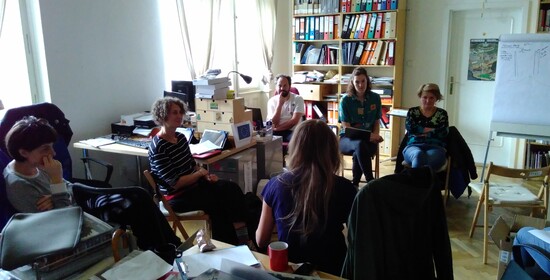
Barbara John participated in the public debate “Europe” which was part of the festival of Dialogue of Cultures of the Multicultural Centre, Prague. In her presentation she introduced “Ten commandments for integration” that she considers essential conditions for successful integration of immigrants.

1. Infrastructure for integration. You cannot just think positively, you need infrastructure, and you need to create some kind of concrete institution. Somebody who is responsible for integration. If you do not have infrastructure, there is no room for communication. One party is for integration, the other against, and this can result in confusion.

2. Institution as a driving force. The institutions responsible for integration do not only have a coordinative role, but they should also concentrate on developing new concepts of integration policy.

3. Political cooperation. The institution responsible for integration does not have the power to change or grant laws; it has the authority to make recommendations and proposals. It would be more beneficial to the cause of integration if there was cooperation between all political institutions. The integration and migration establishment needs the support of the political authorities, and also requires the opportunity to become more heavily involved in high ranking politics; this would enable further success for migration and integration.

4. Contact with everyday problems of immigrants. The office responsible for integration has to be in touch with immigrants to know which problems they face so that it is possible to address, and therefore, amend these difficulties.

5. Participation of majority population. It is necessary to include majority society in the integration process; to inform them about integration policy and to discuss issues of concern with them. If the majority population rejects the ideas of integration of immigrants to its society integration of migrants becomes futile.

6. Integration institution as a leading force in public relation work. The integration institution has to be at the centre of public relations to explain the issues of migration and integration. It should be accessible for the media, to be present in a multitude of events and to produce information brochures for the public. Otherwise, for example, right-wing parties can use the majority population’s fear of immigrants to gain more votes in the elections, etc.

7. Infrastructure for the migrants. To support financially and logistically the creation of organizations for different groups of migrants. If they have access to the necessary organizations they can become a part of public life and thus they can participate fully.

8. Education. For positive participation in the majority society you need access to good education, for example, to ensure that migrant’s children have the opportunity to attend early language education.

9. Labor market. Participation in the labor market is essential. You cannot be integrated if you are unemployed, because you spend the majority of your time at home, thus you do not have the chance to communicate with people outside nor do you have the opportunity to learn the language properly. It would be more beneficial for the state to give additional financial support to those immigrants already in employment rather than to those who are unemployed and dependent on the state.

10. Protection against discrimination. You need laws and regulations to protect immigrants against discrimination.


[1] The total population of Berlin is nearly 3, 4 million.


czechmade_logo_clanky.JPG

The article is a part of the project "Czech Made?" realized by the Multicultural Centre Prague and supported by the European Commission.

Barbora Tošnerová
Barbora Tosnerova [mise(AT)mkc.cz] studied Western European Studies at the Faculty of Social Sciences of the Charles University and Portuguese language at the Classic University in Lisbon. She is currently interested in labour migration in the Czech Republic and in Europe.

Comments


MIGRATION ONLINE is part of OSF MIGRATION PROGRAM 2003; Multicultural
Centre Prague
ISSN 1803-6589
Webdesign: VLHAdesign
Webhosting, a CMS TOOLKIT: ECONNECT

   WE RECOMMEND: